New Jersey
On the RoadNew Jersey frames both ends of Sal Paradise’s relationship to the American road. It is where he begins his 1947 journey west with a map and fifty dollars, and where, years later, he sits beside a broken-down river pier contemplating the continent and remembering Dean Moriarty. The state matters less as a bounded destination than as a threshold: a place from which the road opens outward and to which memory returns, without resolving what became of the people who traveled it.
Departure and the mapped road
In July 1947, Sal left for the West Coast after saving about fifty dollars from veteran benefits. A letter from his old prep-school friend Remi Boncoeur had promised a possible berth on an around-the-world liner and a place to write in a shack at Mill City. Sal left a half-finished manuscript on his desk, packed a canvas bag, and set out with his aunt’s blessing, though her chief wish was that he return in one piece.
For months in Paterson, Sal had pored over maps and read about pioneers, savoring names from the country’s westward history. His road map showed Route 6 running from Cape Cod to Ely, Nevada, then dipping toward Los Angeles; he resolved to follow it to Ely. To reach the route, he traveled by subway to the end of Seventh Avenue, took trolleys through Yonkers, and began hitchhiking north toward Bear Mountain. The route’s first movement away from home thus went in the wrong-seeming direction: north, before west.
Bear Mountain and the eastern wilderness
At Bear Mountain, the planned line on the map gave way to rain, exposed road, and isolation. Five rides had brought Sal to the mountain pass, where Route 6 curved in from New England and disappeared into wilderness. With no traffic or shelter, he ran beneath pine trees, cried, swore, and struck himself for having been foolish enough to begin. He was only forty miles north of New York, yet already felt stranded at the northernmost point of his intended westward departure.
An abandoned English-style filling station offered only a dripping eave beneath the mountain’s thunder. The scene unsettled Sal’s assumption that American wilderness belonged to the West. Later, after encountering the elusive Ghost of the Susquehanna on his return east, he recognized another wilderness in eastern Pennsylvania, Maryland, and Virginia: wooded backroads and dark roads curving among rivers. The eastern landscape, including the country around his New Jersey starting point, was not merely the civilized opposite of the West; it carried its own older histories and uncertainties.
A repeated geography of return
The novel’s routes repeatedly bring Sal back through familiar eastern and Midwestern places, making geography a record of experience as well as a means of movement. On a later bus journey home in October, he crossed the Arizona desert, New Mexico, Texas, Oklahoma, and Kansas, reached St. Louis, and watched logs drift down the Mississippi before continuing through Indiana and Ohio. After Pittsburgh, he still faced 365 miles of hitchhiking to New York with only a dime. The long return turns the westward journey’s expansive promise into fatigue, hunger, and the practical urgency of getting home.
The road also makes earlier places newly legible on subsequent crossings. During a later high-speed drive east with Dean in a new Hudson, the group crossed Illinois, passing Davenport and the Mississippi as the dry West gave way to what seemed to Sal the softer East. On another journey the party drove from Denver to Chicago in seventeen hours, covering 1,180 miles, with delays for a ditch, a ranch, and police in Newton, Iowa. These passages make the eastern destination part of an accumulating map: the same roads and river crossings return, but their meaning changes with the travelers, vehicles, and risks attached to them.
New Jersey as the final vantage
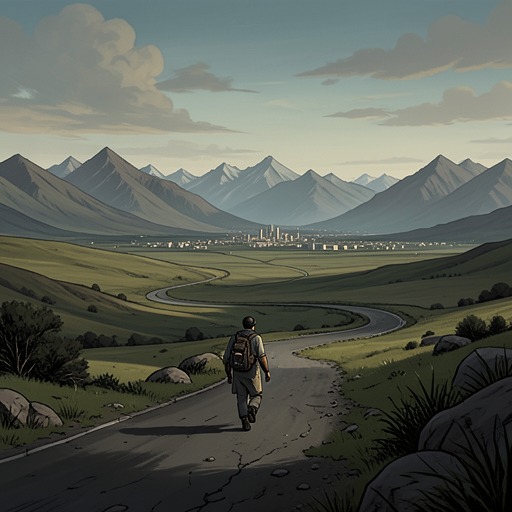
At the close, Sal sits on an old, broken-down river pier and looks across the long skies over New Jersey toward the immense land rolling west to the Pacific. His view gathers the book’s road-going lives into one continental image: people dream within the country’s vastness, while the stars emerge over the prairie and night folds rivers and distant peaks into darkness. The landscape does not promise that movement will disclose a final destination; it emphasizes how much remains unknowable.
From that eastern vantage, Sal thinks of the children crying in Iowa, of the lives that may unfold without warning, and of aging as the one certainty among them. His thoughts return to Dean and to Old Dean Moriarty, the father the friends never found. New Jersey therefore closes the narrative not by ending the road but by turning it into recollection: the starting region becomes a place from which Sal can hold Dean in mind, while the lives and outcomes beyond that memory remain unresolved.